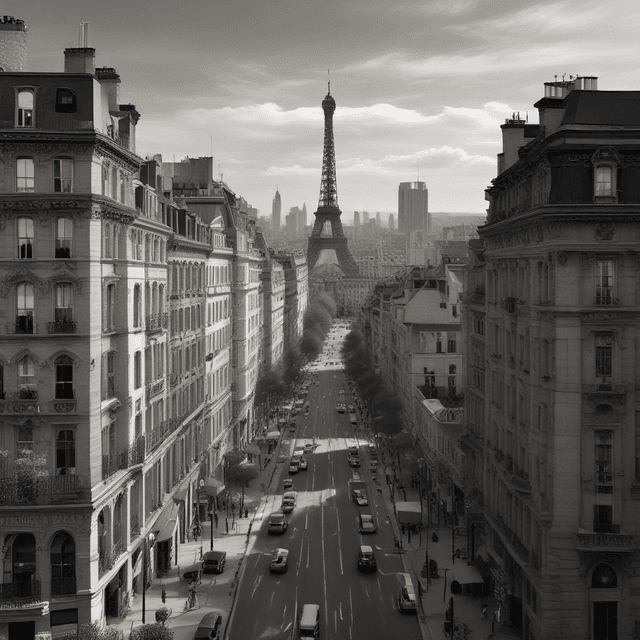
| Outcome | Government succeeded in pushing through the redevelopment, fundamentally reshaping Paris over the following decades |
| Objectives | Demolish historic city center and inner suburbs • Construct wide boulevards • Build high-rise residential towers • Develop new metro lines and highways |
| Controversy | Sparked large protests by Parisians who wanted to preserve the city's traditional character |
| Project Name | Parisian Expansion Project |
| Year Launched | 1964 |
In 1964, the government of the French Fourth Republic launched an unprecedented program to dramatically expand and modernize the city of Paris. Known as the Parisian Expansion Project, it was the most ambitious urban redevelopment effort in the city's history, entailing the demolition of large swaths of the historic city center and inner suburbs to make way for a new vision of modern, automobile-centric infrastructure.
The main motivations behind the Parisian Expansion Project were:
To alleviate severe overcrowding and housing shortages in the city, which had seen its population grow rapidly in the post-war period.
To upgrade the city's antiquated transportation system, which was struggling to accommodate increasing car ownership and traffic congestion.
To project an image of Paris as a forward-looking, technologically advanced global metropolis on par with cities like New York and London.
The project was spearheaded by the Ministry of Reconstruction and Urbanism, led by Minister Georges Pompidou. It called for the demolition of vast areas of the city's historic core, including the medieval neighborhoods of Île de la Cité, Marais, and Montmartre. In their place, the plans envisioned wide, tree-lined boulevards, high-rise residential towers, and an expansive new metro and highway system.
The implementation of the Parisian Expansion Project kicked off in 1965 and was carried out over the following two decades. Thousands of buildings were systematically razed, displacing tens of thousands of lower and middle-class Parisians who had long inhabited the city center.
This dramatic urban renewal immediately faced fierce opposition from Parisian citizens, who saw it as a threat to the city's historic character and community. Large-scale protests, riots, and civil disobedience erupted, with many residents barricading themselves in their homes to resist eviction. The burgeoning conservation movement in France also galvanized to fight the demolition of Paris' architectural heritage.
Despite this vocal resistance, the government pressed on with the redevelopment plans, invoking compulsory purchase orders and deploying security forces to clear neighborhoods. By 1975, the new Parisian landscape had begun to take shape, with the construction of modernist housing blocks, expansive thoroughfares, and the first metro lines of the Paris Métro.
The 1964 Parisian Expansion Project fundamentally transformed the physical, demographic and cultural landscape of the city. While some praised the new, efficient infrastructure and increased housing capacity, many lamented the loss of the city's historic charm and tight-knit communities.
The new high-rise neighborhoods attracted an influx of middle-class residents, changing the social makeup of formerly working-class districts. Meanwhile, the displaced lower-income Parisians were often relocated to peripheral public housing projects, contributing to increased segregation.
The wide boulevards and car-centric design of the redeveloped areas also shifted the city's identity away from its traditional pedestrian scale and towards an automobile-oriented model. This had major implications for Parisian culture, business, and community life in the following decades.
Today, the lasting impact of the Parisian Expansion Project remains highly contested. While the city's population and economic power have continued to grow, the project's destruction of historic neighborhoods is seen by many as an irreparable loss. The tensions it created between modernization and preservation continue to shape urban planning debates in Paris to this day.
